Determination of Azimuth Angle at Burnout for Placing a Satellite Over a Selected Earth Position
Did you know that you can search all of NASA’s Technical Publications that are not classified? Head over to their Technical Reports Server and off you go! It took me a while to find this paper of Ms. Johnson’s as the notoriety of “Hidden Figures” took over most of my search results. However, I managed to find this paper, and others, with a little help from my former supervisor, Thomas Proffen, who I worked for out at Los Alamos National Lab for a few summers.
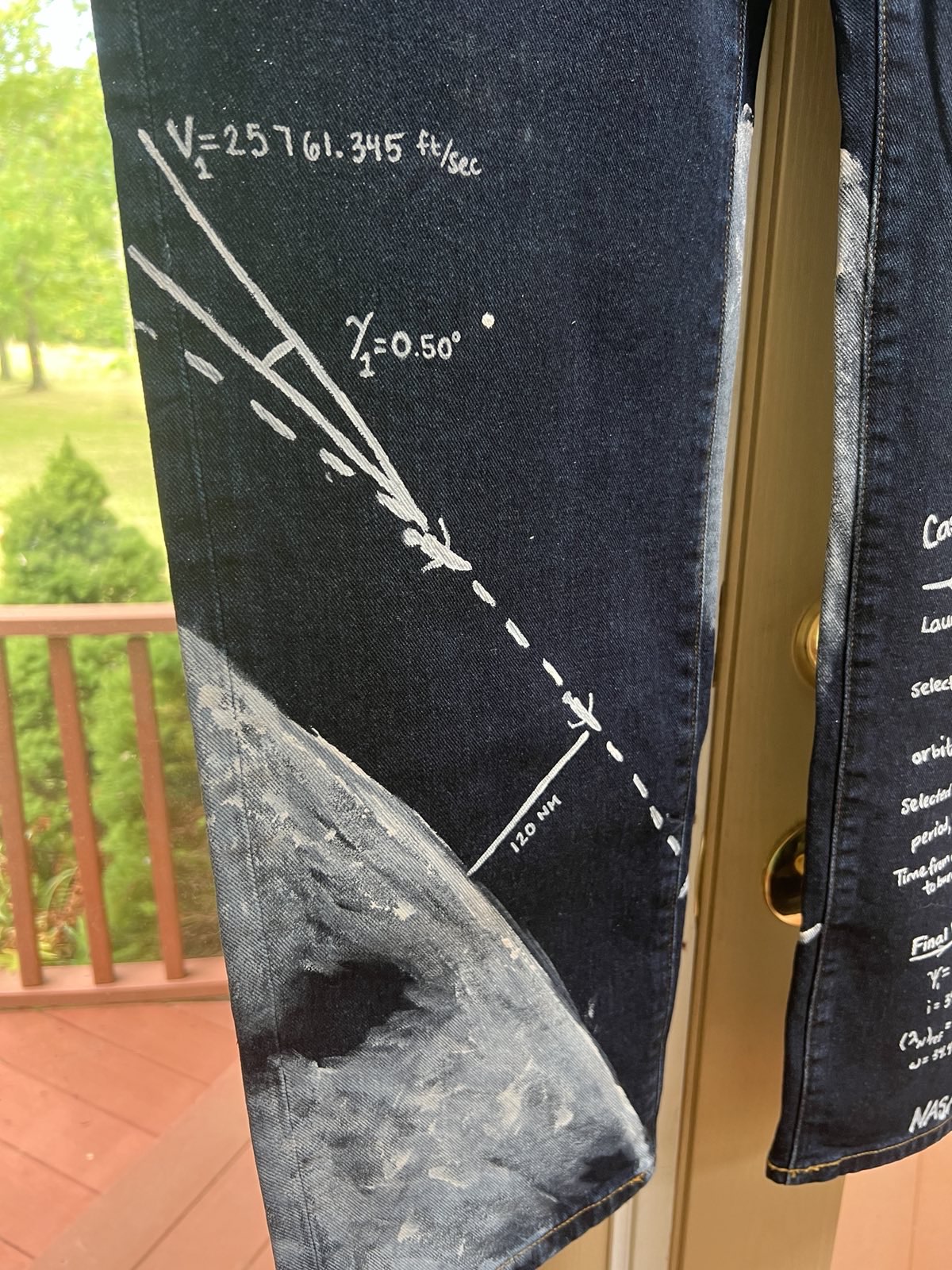
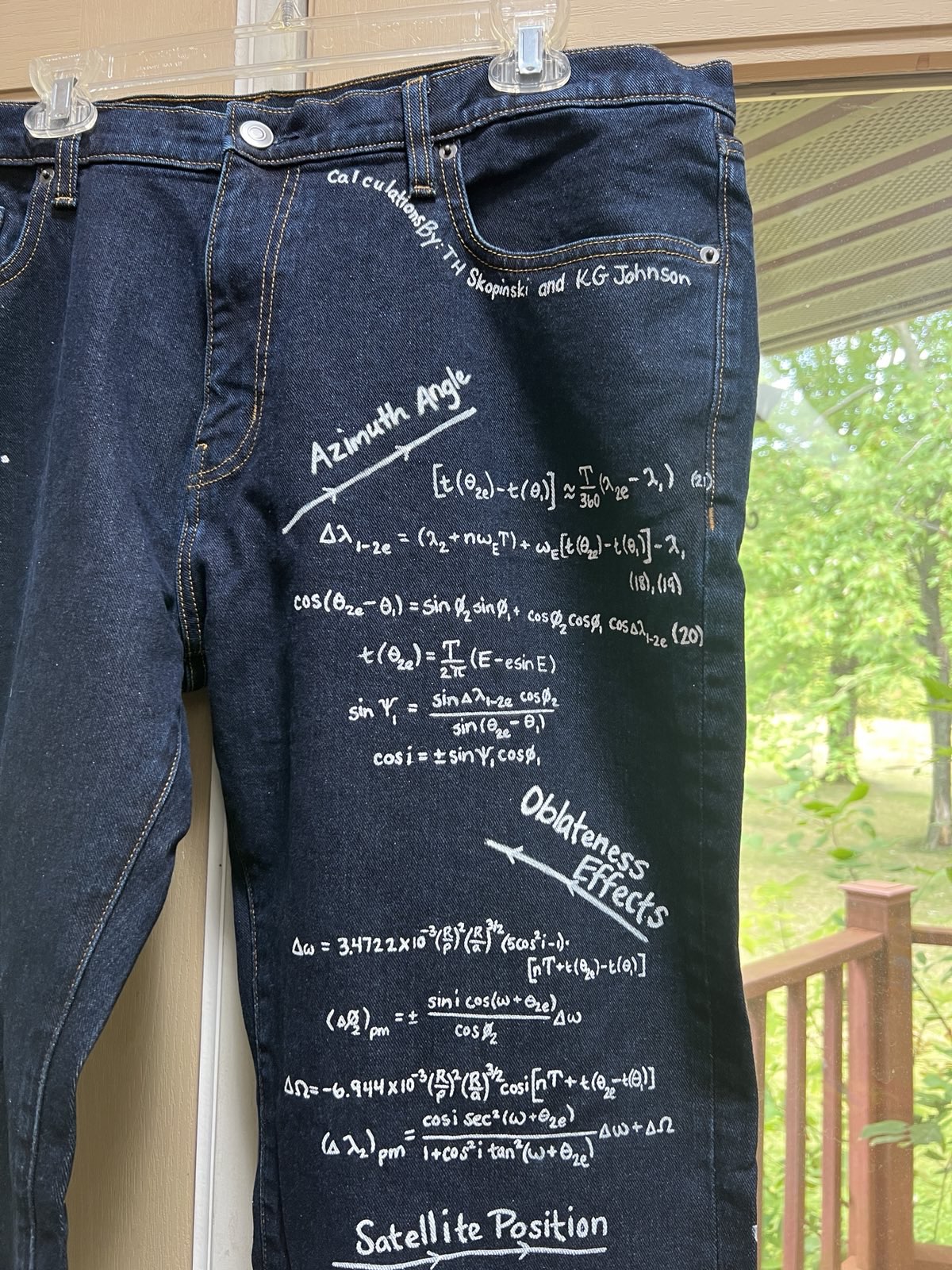
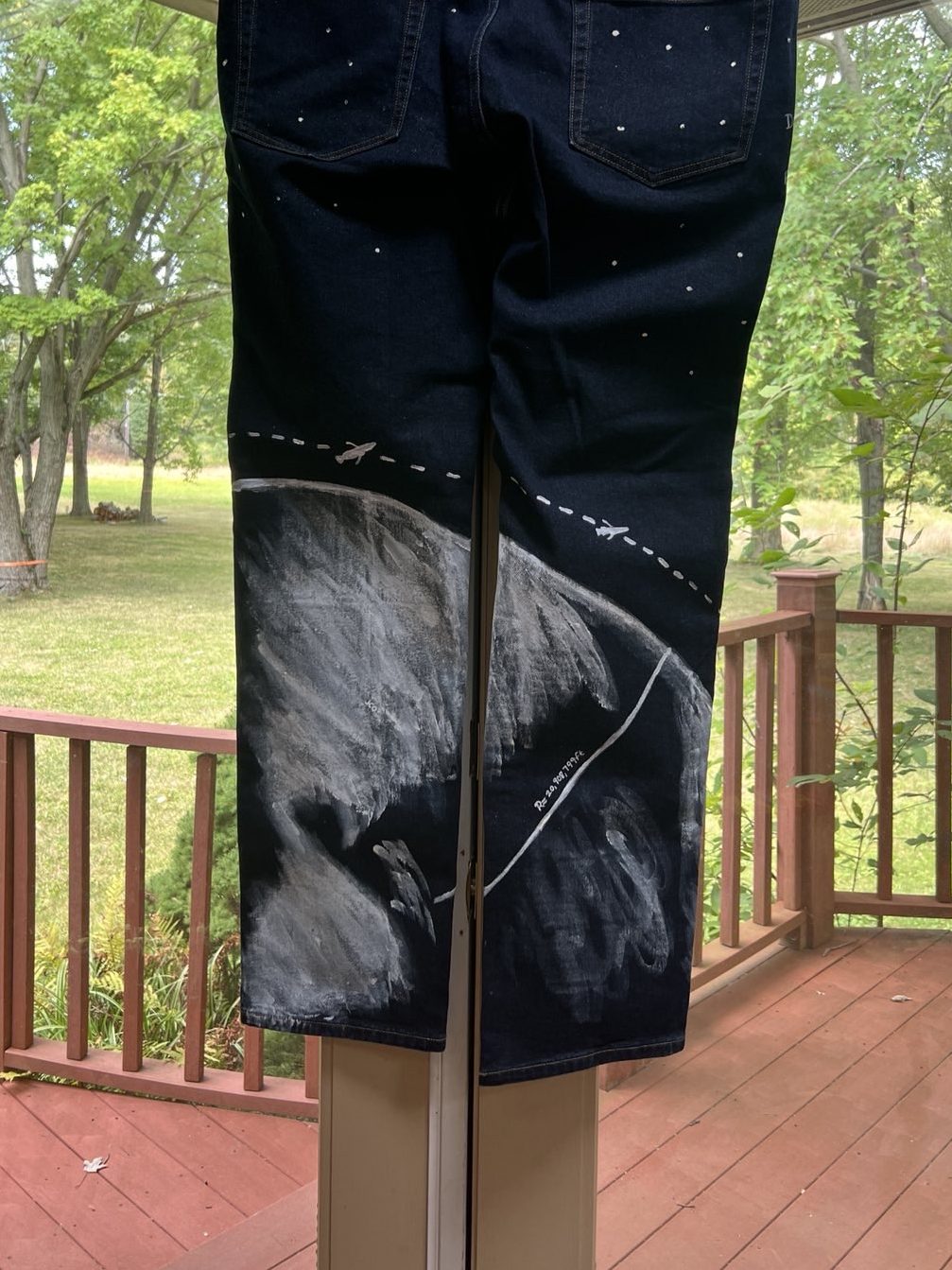
The paper I used to paint these pants was not the “Go – No – Go” Paper from the movie (which I believe is this one), but it is one that focuses on placing a satellite in a certain position above the Earth’s surface – this is similar, but not the resulting paper from the work portrayed in the movie. It details the calculations for both an Eastward and Westward launch of a Earth-made satellite after having made 3 orbits around the Earth in the Orbital Plane – which I believe to be 120 Nautical Miles. Reading through Ms. Johnson’s Technical Note, it was a little bit of a challenge to figure out what equations to include on the pants. There was a part in the other paper where she stated that she used Partial Fraction Decomposition (shout out to all my Advanced Pre-Calc kids who thought it would never be used outside of the class room!) and some trig substitutions in the Pant’s paper. However, much of the calculations seemed to be applied trigonometry, which was cool to see.
The satellite I painted is a nod to one of our satellites launched around the time of this paper called Explorer 1. According to these photos, It seems vastly smaller than I picture any space craft of any kind. I realized I assumed that all space things were at least the size of a semi-truck.
The last fun Science fact I learned that I’ll tell you about was that the Earth is not as spherical as I always assumed. The radius of the Earth at the Equator is larger than that of the radius at the poles. So the Earth is actually more like a ball as it is hitting the ground – the ball would squash a little bit as its particles slowed down to reverse directions. This phenomenon is described as “Oblateness.” This is why there’s a whole section of equations needed for the “Oblateness Effects” [page 20].

References:
Technical Note Used: https://ntrs.nasa.gov/api/citations/19980227091/downloads/19980227091.pdf
Satellite Painting Reference: https://www.nasa.gov/history/explorer-1-overview/
Awesome NASA Search Engine I used: https://ntrs.nasa.gov/search
 - Ness by Julie